Showing posts with label Other. Show all posts

Tuesday, 31 December 2013

Weather on planet outside our solar system detected for first time

The weather on a "super-Earth" orbiting a star 40 light years away is the first to be detected outside our solar system 

Researchers have predicted that it is set to remain cloudy and hot on the planet GJ 1214b for a long time to come


Scientists have issued a weather forecast for a planet outside our solar system for the first time, with the alien ''super-Earth'' orbiting a star 40 light years away set to remain cloudy and hot for the foreseeable future.

Using Hubble, they found exoplanet GJ 1214b has cloudy skies and is overcast all of the time, which would make forecasting pretty predictable - and boring.

Researchers have predicted that it is set to remain cloudy and hot on the planet GJ 1214b for a long time to come.

The world orbits very close to its ''red dwarf'' parent star, raising temperatures to a scorching 232C.

Using the Hubble Space Telescope to study light filtering through the planet's atmosphere, US astronomers determined that it is shrouded by high-altitude clouds. 

What they are made of is still unknown, but computer simulations suggest they could be composed of potassium chloride or zinc sulphide dust.

Earlier studies of the planet were not able to tell whether it had clear or cloudy skies. 

Now scientists are confident it is both hot and permanently overcast - a little like Venus in our own Solar System.

As was the case with Venus until the era of space probes, the cloud cover makes it impossible to know what the planet 's surface is like.

Super-Earths, planets having a mass between that of the Earth and Neptune, are believed to be among the most common in our galaxy, the Milky Way. GJ 1214b, whose star lies in the constellation Ophiuchus, is roughly 2.7 times larger than the Earth.

Dr Jacob Bean, leader of the University of Chicago astronomers - whose results appear in the journal Nature, said: ''I think it's very exciting that we can use a telescope like Hubble that was never designed with this in mind, do these kinds of observations with such exquisite precision, and really nail down some property of a small planet orbiting a distant star.''

The observations took up 96 hours of Hubble Telescope time spread over 11 months - the longest period ever devoted to studying a single exoplanet with the space telescope.

Dr Bean's team analysed near-infrared light from the planet each time it passed in front of, or ''transited'', its star, an event that occurs every 38 hours.

Writing in Nature, the scientists described the findings as an important milestone on the way to identifying potentially habitable Earth-like planets among the stars. 

GJ 1214b was discovered in 2009 by the MEarth Project, which searched for planets transiting 2,000 red dwarfs, abundant stars dimmer than the Sun.

Follow-up observations suggested that the planet's atmosphere was either mostly composed of water vapour or dominated by hydrogen with high-altitude clouds.

The new study ruled out a cloud-free atmosphere of water, methane, nitrogen, carbon monoxide or carbon dioxide.

A ''flat'' signal from the Hubble data, lacking chemical fingerprints, indicated the presence of high altitude clouds of uncertain composition shielding what lay beneath.

The US space agency Nasa's 6.5 metre James Webb Space Telescope, due to be placed in orbit later this decade, is expected to reveal more information about exoplanet atmospheres.

''Looking forward, JWST will be transformative,'' said graduate student Laura Keidberg, another member of the University of Chicago team.

''The new capabilities of this telescope will allow us to peer through the clouds on planets like GJ 1214b. But more than that, it may open the door to studies of Earth-like planets around nearby stars.''


Saturday, 14 December 2013

AMT to buy Deux-Montagnes line from CN: report

In the future, this may be the only type of train on the Deux-Montagnes line.

POINTE-CLAIRE – The Montreal Gazette is reporting that CN has agreed to principle to sell its tracks along the Deux-Montagnes line to the island’s suburban rail service, the AMT.

According to Clifford Lincoln, the longtime advocate of the West Island Train, “I’m sure we could triple ridership with proper service.”

Officials are looking at the development as an important step toward improving commuter train service in Montreal’s suburbs. The commuter trains split time with freight, meaning that during off-peak commuter hours, raw materials are taking the place of potential passengers.

“My thought would be if they were to purchase the CN line, and they could give priority to the passenger trains, that would be great,” said Pointe-Claire Mayor Morris Trudeau.

Trudeau’s jurisdiction includes three AMT stations, but on the Vaudreuil-Hudson line. The tracks that line uses are owned by CP. Many in Pointe-Claire are hoping the AMT buys CP out of its own rails.

“Their main concern is the lack of service- plain and simple,” Trudeau said. “They have so many trains a day going to and from Montreal. And there are huge gaps.”
A CP spokesperson told Global News that there are currently no plans to sell the Vaudreuil-Hudson tracks. The AMT refused to comment on the matter.

IRIS Glimpses an Elusive Region of the Sun

alan.title_.003
IRIS versus SDO. The IRIS image to the right is looking at solar activity in ionized Silicon IV wavelengths.

An innovative solar observatory is adding a key piece to the puzzle of the enigma that is our Sun.

Its two of key questions in heliophysics: why does our Sun have a corona? And why is the temperature of the corona actually higher than the surface of the Sun?
This week, researchers released results from the preliminary first six months of data from NASA’s Interface Region Imaging Spectrograph, known as IRIS. The findings were presented at the Fall American Geophysical Union Meeting this past Monday.

IRIS was launched on June 27th of this year on a Pegasus-XL rocket deployed from the belly of a Lockheed L-1011 aircraft flying out of Vandenberg Air Force Base. IRIS can focus in on a very specific interface region of the Sun sandwiched between the dazzling solar photosphere and the transition to the corona. To accomplish this, IRIS employs an ultraviolet slit spectrograph looking at ionized gas spectra.

IRIS in the clean room. The spacecraft is only about 2 metres in length, about the height of a person. (Credit: Lockheed Martin).
IRIS in the clean room. The spacecraft is only about 2 metres in length, about the height of a person.

“The quality of images and spectra we are receiving is amazing,” IRIS Principal Investigator Alan Title said in a recent press release from the NASA Goddard Space Flight Center. While other missions may take over a decade to go from the drawing board to the launch pad, IRIS was developed and deployed into Low Earth Orbit in just 44 months.

IRIS offers scientists a new tool to probe the Sun and a complimentary instrument to platforms such as Hinode, the Solar Heliospheric Observatory (SOHO) and NASA’s Solar Dynamics Observatory. In fact, IRIS has a better resolution than SDO’s AIA imagers or Hinode when it comes to this key solar interface region. IRIS has a 20x greater resolution in time, and 25x the spatial resolution of any former space-based UV spectrometer deployed.

“We are seeing rich and unprecedented images of violent events in which gases are accelerated to very high velocities while being rapidly heated to hundreds of thousands of degrees,” said Lockheed Martin science lead on the IRIS mission Bart De Pontieu. These observations are key to backing up theoretical models of solar dynamics as well as testing and formulating new ones of how our Sun works.

IRIS bridges this crucial gap between the photosphere and the lower chromosphere of the Sun. While the solar surface roils at relatively placid  6,000 degrees Celsius, temperatures rise into the range of 2-3 million degrees Celsius as you move up through the transition region and into the corona.

Two key solar phenomena that are of concern to solar researchers can be examined by IRIS in detail. One is the formation of prominences, which show up as long looping swirls of solar material rising up from the surface of the Sun. Prominences can be seen from backyard telescopes at hydrogen alpha wavelengths. IRIS can catch and track their early modeling with unprecedented resolution. Images released from IRIS show the fine structure of targeted prominences as they evolve and rise off the surface of the Sun. When a prominence and accompanying coronal mass ejection is launched in our direction, disruption of our local space environment caused by massive solar storm can result.
Slit jaw spectra images (the two strips to the left) and imaging a spicules 9to the right as seen by IRIS. (Credit: NASA/IRIS).
Slit jaw spectra images (the two strips to the left) and imaging of spicules (to the right) as seen by IRIS.

The second phenomenon targeted by IRIS is the formation of spicules, which are giant columns of gas rising from the photosphere. Although the spicules look like hair-fine structures through Earth-based solar telescopes, they can be several hundred kilometres wide and as long as the Earth. Short-lived, spicules race up from the surface of the Sun at up to 240,000 kilometres per hour and seem to play a key role in energy and heat transfer from the solar surface up through the atmosphere. IRIS is giving us a view of the evolution of spicules for the first time, and they’re proving to be even more complex than theory previously suggested.
 
“We see discrepancies between these observations and the models, and that is great news for advancing knowledge. By seeing something we don’t understand, we have a chance of learning something new,” Said University of Oslo astrophysicist Mats Carlsson.

Like SDO and SOHO, data and images from IRIS are free for the public to access online. Though the field of view for IRIS is a narrow 2’ to 4’ arc minutes on a side – the solar disk spans about 30’ as seen from the Earth – IRIS gives us a refined view of “where the action is.”

Where is IRIS looking? This snapshot gives some context of the IRIS field of view (green and red boxes) and black and white insets versus SDO's AIA full disk view of the Sun. (Credit: NASA/SDO/IRIS).
Where is IRIS looking? This snapshot gives some context of the IRIS field of view (green and red boxes) and black and white insets versus SDO’s AIA full disk view of the Sun.
And this all comes at an interesting time, as our nearest star crosses the sputtering solar maximum for Cycle #24.

The equivalent of 50 million CPU hours were utilized in constructing and modeling what IRIS sees. The reconstruction was an international effort, spanning the Partnership for Advanced Computing in Europe, the Norwegian supercomputing collaboration, and NASA’s Ames Research Center.

IRIS also faced the additional challenge of weathering a 2.5 week period of inactivity due to the U.S. government shutdown this fall. Potential impacts due to sequestration remain an issue, though small explorer missions such as IRIS demonstrate how we can do more with less.

“We’ve made a giant step forward in characterizing the heat transfer properties of this region between the visible surface and the corona, which is key to understanding how the outer atmosphere of the Sun exists, and is key to understanding the outer atmosphere that the Earth lies in,” said Alan Title, referring to the tenuous heliosphere of the Sun extending out through the solar system.
Understanding the inner working of our Sun is vital: no other astronomical body has as big an impact on life here on Earth.

IRIS is slated for a two-year mission, though as is the case with most space-based platforms, researchers will work to get every bit of usefulness out of the spacecraft that they can. And it’s already returning some first-rate science at a relatively low production cost. This is all knowledge that will help us as a civilization live with and understand our often tempestuous star.

Friday, 22 November 2013

S3 Android 4.3 update rolls out on T-Mobile and AT&T, Sprint imminent

Galaxy S3 owners in the US might be more afraid of the impending Android 4.3 update than excited about it. Considering the huge array of problems the update has already brought for Verizon customers, you may not even want to install the update as soon as you can. The new update will bring the Knox security platform to your device as well as support for Samsung's smartwatch,Galaxy Gear, if it actually works for you.
S3 Teaser Update
Android 4.3 is here for the S3, but do you really want it?
Verizon rolled out the update for the Galaxy S4 first and sparked the debate in the States about Samsung's appalling job of testing the firmware. Now T-Mobile and AT&T customers will get some fresh Jelly Bean action driving their S3. Sprint customers will have to wait a little longer yet. So far we're not sure if the numerous bugs have somehow been fixed in these carrier releases of Samsung's update to the Android operating system but reports from users show a mixed bag of results so far.
T-Mobile released the update a couple of days ago, but it is only for the older non-LTE model, T999, not the T999L model which supports 4G network speeds. AT&T have finally released the update today after a short delay at Samsung's request. Sprint hasn't announced anything yet, but a final build version, assumed to be for Sprint, has appeared on Samsung's Open Source Release Center. Samsung is also stating the Sprint S3 is running Android 4.3 on their website, meaning the update is very close indeed.
androidpit galaxy s3 android 4 3 1
The international version Galaxy S3 got 4.3 along with many problems. 
If the update hasn't already appeared on your device, you have some options: you can access it OTA via Settings > About Device > Software Update > Check Now. You will either get the update started or see the message: ''The device is up to date,'' meaning it is not yet available for your area. If this happens you can either try again later, or manually update via Kies. Just download the latest Kies software, connect your S3 to your computer and click ''Update.'' Make sure you have performed a full backup of your data first just in case anything goes amiss.
If you download the update and hate it, you can follow our tutorial to downgrade your S3 back to Android 4.1.2
Have you received the Android 4.3 update yet? How is it working for you so far?

Courtesy :AndroidPIT

Friday, 15 November 2013

Sound and vision: How technology is making cities safer

Using surveillance to make cities safer
Thursday, 14 Nov 2013 | 7:41 PM ET
In the final episode of our theme week on 'Innovation Cities,' Tom Mackenzie takes a look at the new technology designed to help make us all more secure.
Singapore's government has worked with Accenture, the management and technology consultancy, using video analytics to help stop crime. Facial recognition technology is used on streets to identify suspects, suspected gang members, and those on wanted lists.
"We're still in the early stages of that programme, but we're hoping that there will be results showing that this technology can make a real difference to public safety in a more cost-effective way, but also in a more effective way," Ger Daly, Global Managing Director of Defense and Public Safety, Accenture, said in a report for CNBC's Innovation Cities.
As well as using facial recognition software, the technology developed by Accenture can scan the way we move and assess whether a crime is being committed. "Now the technology can even detect patterns, so for example people fighting or break-ins at shops," Daly added.
"It can pick up that behaviour just from the shapes and the movement of the people and generate an alert even if nobody is watching that television feed."
For some, the use of this kind of technology conjures visions of Orwell's Big Brother: where our every single movement and action is surveyed by the state. But Daly argues this kind of technology is already in use. "Biometric data has become a very important part of identifying people, it can be your fingerprints, it can be your iris, but it could also be your face," he said.
"The technology is there, today…to really uniquely identify you and me and other people just by the patterns and shape of our face," he added. "What maybe people don't realise is that they're actually using it already today. All new passports have… the chip symbol. It has your personal information on it, same as what's printed on the passport. But it also has your face as a biometric identifier."
Tracking illegal activity and criminals using facial recognition is one thing. Being alerted to offences by sounds is another. ShotSpotter, a U.S. company, has developed innovative acoustic surveillance technology that can detect gunfire and alert authorities to its location.
Joern Haufe | Getty Images
In 2011, the Minneapolis Police Department used ShotSpotter to great effect. "The system that we have of integrating our public safety cameras with ShotSpotter… [was] able to help us identify and catch the suspects in a homicide," Commander Scott Gerlicher said this week.
"When we had a drive by shooting at a local convenience store, the ShotSpotter audio system captured the shots and our camera, which happened to be located at the corner where this incident occurred, also captured video tape of the vehicle actually doing the shooting," he added.
With rapid advancements in security technology, are we nearing a future when police officers on the ground become redundant? "Technology has its limitations and it's not meant to replace police officers," Gerlicher said.

Sunday, 10 November 2013

The brief life of polywater, the water that 'doesn't freeze'

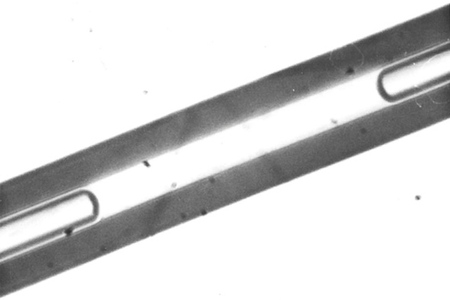
polywater NIST

In the 1960s, scientists in the US and Russia independently discovered a new form of water that was 40 percent denser, didn't solidify until 40 degrees below Celsius, and didn't seem to boil no matter how much it was heated. They called it polywater, and its mysterious properties flummoxed researchers for years — until a California scientist figured out what they'd been missing all along.