Showing posts with label Electronics. Show all posts

Tuesday, 7 January 2014

CES Unveiled: Toys, Fitness, Surveillance & IoT

From cleverly designed toys and wellness devices to alternative energy ideas and device virtualization software for the Internet of Things, International CES has got it.

CES, which started out strictly as a tradeshow for dealers of audio/video and home entertainment systems, has become the annual make-or-break showcase for startups, software designers, and propeller-heads to test innovative product concepts, breakthrough technologies, and clever application ideas among fellow engineers, marketers, consumer electronics OEMs, and investors who gather here at the convention center.

The opening gadget salvo is called "CES Unveiled," a sort of indoor Maxwell Street for new technology and product ideas, all complicated by the presence of food tables and unlimited free alcohol. We don't know how many Unveiled newborns will be commercialized by the end of the year, let alone how big a commercial success any one might become.

Following is a sampling of the products (and sometimes prototypes) that caught our eye this year. (My colleague Jessica Lipsky here at CES also contributed to this story.)

Parrot offers toys as well designed as cars

Paris-based Parrot, always a crowd pleaser on the CES show floor, returned to show off the company's two new gadgets: its new-generation personal drone, called "Micro Drone," equipped with indoor wheels to roll on the floor or the ceiling; and a smartphone-controlled robotics device, "Jumping Sumo," that jumps 2.5 feet in the air but always lands on its wheels.


Demonstrating his new toys, Henri Seydoux (second from the right in the photo above), the founder and CEO of Parrot, told EE Times: "These are not quick gadgets. They are toys that are as serious and as well designed as cars."

Indeed, they are robust. Parrot's new Micro Drone comes with an unprecedented automatic stabilization system. Jumping Sumo, with embedded camera, can even make 90 degree turns at high speed, while its foldable wheels control speed and enable tricky moves.

Parrot's Jumping Sumo.


Samsung Electronics down 18% to $7.8 billion, misses street estimates

Samsung said October-December operating profit fell 18 per cent to 8.3 trillion won ($7.8 billion) from the prior quarter's record earnings

Samsung Electronics Co Ltd said October-December operating profit fell 18 per cent to 8.3 trillion won ($7.8 billion) from the prior quarter's record earnings, missing analyst estimates, due primarily to a one-off special bonus.

Samsung is bracing itself for its weakest smartphone profit growth this year since it started making the devices in 2007, as arch rival Apple Inc challenges its domination in China's $80 billion market.

Samsung's mobile devices business, which earns two thirds of the company's profit, will come under pressure when Apple makes its phones available from Jan. 17 via ChinaMobile Ltd , through which Samsung has been selling smartphones for around seven years.

Apple is also widely expected to sell smartphones with larger screens come autumn when it traditionally announces products, neutralising a selling point that Samsung has enjoyed since introducing its Galaxy Note in late 2011.

"Even taking into account one-off costs, the profit is lower than expected. Samsung has not provided details, but smartphone profit may have fared worse than expected, given increased marketing expenses," said Lee Seung-woo, an analyst at IBK Investment & Securities.

The guidance, released on Tuesday ahead of full quarterly results scheduled for Jan. 24, was lower than a 9.75 trillion won Thomson Reuters' Starmine SmartEstimate of 23 analysts, which gives greater weighting to the more accurate analysts.

At 8.3 trillion won, it was even below the most bearish forecast of 8.8 trillion won, and was the lowest since the 8.06 trillion won of the third quarter of 2012.

The reading would be 18 per cent less than the record 10.2 trillion won of July-September as Apple enjoyed buoyant sales in the United States and Japan during the year-end holiday season.

Fourth-quarter earnings were also likely pulled down by a special bonus related to the 20th anniversary of the "New Management" strategy of Chairman Lee Kun-hee, which analyst estimates put at 300 billion to 700 billion won.

"Samsung's special incentive payments to employees including domestic and overseas units appear to have been much larger than the market expected; marketing costs of its mobile business might have also been larger," said Kim Young-chan, tech analyst at Shinhan Investment Corp.

The South Korean firm estimated its fourth-quarter sales at 59 trillion won, versus a market forecast of 61 trillion won.

Samsung shares have been pummelled in recent weeks by 22 analysts downgrading fourth-quarter earnings estimates over the past 30 days.

The shares, worth $190 billion, fell 10 per cent over the past fortnight to a 4-month low last week, wiping off market value to the tune of $19 billion - equal to the total value of shares of Sony Corp.

The won's rise to a five-year high against the US dollar has also been prompting investors to sell, as a strong won reduces the value of Samsung's repatriated earnings.

Saturday, 4 January 2014

60 GHz DuoTargets Small Cells


 InterDigital Inc. and BluWireless Technology are in discussions about designing a reference board for 60 GHz backhaul on small cell base stations. The proposed board would create a mesh network supporting links that deliver 2 Gbits/s over 150 meters and be finished before June 2015.

The work is part of a rising tide of efforts leveraging the IEEE 802.11ad standard defining 60 GHz WiFi to serve base station backhaul and eventually access networks. Late last year 60 GHz startup Peraso announced its already sampling a module for small cell backhaul based on .11ad, competing with existing products from Hittite Microwave and others expected from companies such as Infineon or Intel.

Carriers are moving to small cell base stations to deliver more network capacity in urban areas. Some believe 60 GHz links could be the best way to tie such cells into the carrier network.

Some base stations already used fixed point-to-point 60 GHz links for backhaul in products that cost thousands of dollars. The new collaboration aims to enable products with mesh networking costing a few hundred dollars. The duo plans to include on the board electrically steerable phased array antennas from unnamed partners to enable beam steering in the mesh network.

One report cited by InterDigital forecasts that a third of WiFi links will support 60 GHz by 2018. "We're interested in 60 GHz because its unlicensed spectrum and the technology has market momentum," said Doug Castor, a principal engineer heading up the project at the company.

InterDigital is supplying some mesh networking and media access controller technology as part of the collaboration. BluWireless is a chip intellectual property provider with physical layer technology for 60 GHz.

Saturday, 14 December 2013

LG Electronics Awarded 'Project Of The Year' By Economic Development Association Of New Jersey

The Economic Development Association of New Jersey (EDANJ) today honored LG Electronics with the "Development Project of the Year Award" for the new LG North American headquarters under construction in Englewood Cliffs.

Presenting the award here today at the EDANJ's annual economic development awards luncheon, Maggie Peters, Director of the Bergen Country Economic Development Corporation (BCEDC) and Board Director of the EDANJ, commended LG on its $300 million investment in Englewood Cliffs, saying:  

LG Electronics Awarded 'Project Of The Year' By Economic Development Association Of New Jersey

"This project is a prime example of the kind of robust economic development our state needs. This world-class green building will deliver enormous economic benefits to Englewood Cliffs, Bergen County and the State of New Jersey."

The new LG North American headquarters, for which the company is receiving no government incentives, will allow LG to expand its workforce from 500 today to 1,200 by 2017 and 1,600 by 2020 and in the interim it will create thousands of construction jobs. According to an economic impact study* released by Bergen County officials in September, the project is expected to bring more than $500 million to the State of New Jersey over a 20-year period. In addition, LG's new headquarters will bring a total of $2.5 million in annual tax revenue to Englewood Cliffs, where the municipal budget is about $13.5 million

"LG is extremely proud of this project, and we are enthusiastic to begin the construction process after years of planning and approvals," said Wayne Park, President and CEO of LG Electronics USA. "The Development Project of the Year award reaffirms the many benefits LG's new building will bring to the region now and for decades to come."

The EDANJ was formed in 1953 to promote a sound economy in the State of New Jersey and to provide an exchange of professional and technical information with respect to economic development. Complementing the presentation of the annual Economic Development Awards, The Development Project of the Year was established in 2013 to celebrate LG Electronics' investment in the region and will be awarded to other worthy projects in the region for years to come.

The research was conducted by Biggins Lacy Shapiro & Company (BLS Strategies) and independently confirmed by the New Jersey Economic Development Authority (NJEDA).

About LG Electronics USALG Electronics USA, Inc., based in Englewood Cliffs, N.J., is the North American subsidiary of LG Electronics, Inc., a $45 billion global force and technology leader in consumer electronics, home appliances and mobile communications. LG Electronics, a proud 2013 ENERGY STAR Partner of the Year, sells a range of stylish and innovative home entertainment products, mobile phones, home appliances, commercial displays, air conditioning systems and solar energy solutions in the United States, all under LG's "Life's Good" marketing theme. For more information about LG Electronics, please visit www.lg.com.For more information about the North American headquarters building, please visit LGenglewoodcliffs.com

Monday, 9 December 2013

Growth of Sensors Industry in Consumer Electronics 2020 Forecasts in New Research Report at RnRMarketResearch.com

Although sensors in consumer electronics have been in the market for quite a long time, the high power consumption and large size with the associated cost has been limiting their applications to new products like wearable devices. However, this scenario is rapidly changing with the market consistently moving towards smaller size of IC chips, which could help in reducing the overall cost of ownership to a great extent. The use of sensors for upcoming applications in health monitoring, indoor navigation will surely drive this market to new horizons.
This research study on the sensors market in consumer electronics focuses on various product segments such as Touch, Image, Motion, Pressure, Position and Temperature Sensor. While Touch and Image are relatively mature product segments, Motion and Pressure are expected to grow at higher CAGRs during the forecast period. Apart from these product segments, the report is sub segmented by applications such as Entertainment, Information Technology, Communication Products, and Home Appliances.
The report also draws the competitive landscape of the global sensors market in consumer electronics, analyzing the major players and the strategies adopted by them for growth in the market.Apart from the market segmentation data, the report also includes qualitative analysis of various market dynamics such as the drivers, restraints, opportunities, burning issues, and winning imperatives. It also analyzes the overall market through various models; such as the Porter’s five forces model. The report includes profiles of major market players with their respective market share analysis.
Major players in this sensors market include Sony Corp (Japan), STMicroelecronics (Switzerland), Aptina Imaging (US), Synaptics (US), Cypress Semiconductors (U.S.), Bosch Sensortec (Germany), Freescale Semiconductors (U.S.), Omnivision Technologies (US), AKM Semiconductors (US), Samsung (Japan), Texas Instruments (US) and so on.
Majors point of table of content
7 Company Profile
7.1 3M Co.
7.2 Alps Electric Co., Ltd.
7.3 Analog Devices, Inc.
7.4 Aptina Imaging Corporation
7.5 Atmel Corporation
7.6 Avago Technologies Ltd.
7.7 Banner Engineering Corp.
7.8 Cypress Semiconductor Corporation
7.9 Elliptic Laboratories As
7.10 Elmos Semiconductor Ag
7.11 Epcos AG
7.12 Eyesight Mobile Technologies Ltd.
7.13 Freescale Semiconductor Ltd.
7.14 Infineon Technologies Ag
7.15 Invensense, Inc.
7.16 Measurement Specialties, Inc.
7.17 Melexis Nv
7.18 Murata Manufacturing Co., Ltd.
7.19 NXP Semiconductors N.V.
7.20 Omnivision Technologies, Inc.
7.21 Panasonic Corporation.
7.22 Pointgrab Ltd.
7.23 Robert Bosch Gmbh
7.24 Samsung Electronics Co. Ltd.
7.25 Semtech Corp.
7.26 Sensirion Ag
7.27 Synaptics, Inc.
7.28 Teledyne Dalsa Inc.
7.29 Texas Instruments Inc.
7.30 Toshiba Corporation
7.31 XYZ Interactive Technologies Inc.
About Us:
RnRMarketResearch.com is an online database of market research reports offer in-depth analysis of over 5000 market segments. The library has syndicated reports by leading market research publishers across the globe and also offer customized market research reports for multiple industries.

China's Haier Electronics hit 14 year high on Alibaba logistics deal

An employee arranges stools at a section displaying Haier television sets inside a Suning store in Shanghai August 26, 2013. REUTERS/Aly Song
An employee arranges stools at a section displaying Haier television sets inside a Suning store in Shanghai August 26, 2013.


Chinese appliance maker Haier Electronics Group Co Ltd agreed to team with e-commerce giant Alibaba Group to further develop its logistics business, in a move that sent Haier Electronic's stock to a 14-year high.
The joint venture, announced through a stock exchange filing, includes several parts, for a total deal value of HK$2.8 billion ($361.09 million).
Haier's shares soared 20 percent to HK$22.35 in early morning trade, the highest since February 2000, outpacing a 0.7 percent gain in the benchmark Hang Seng Index. The company's stock is up 95 percent on the year to date.
Haier Electronics is muscling in on their distributors and expanding into logistics and e-commerce in a bid to win the fierce battle for margins in the world's biggest home appliance market. The company's largest shareholder is KKR-backed Qingdao Haier Co Ltd, which owns a 47.9 percent stake.
The agreement also comes amid a flurry of deals by fast growing Alibaba, which has bought into several companies recently and is preparing what could be a roughly $15 billion IPO.
As part of the deal, Alibaba will hold a 9.9 percent stake in the joint venture with Hong Kong-listed Haier Electronics, which manufactures and sells washing machines and water heaters.
Alibaba will also subscribe for about 2 percent of Haier Electronics' enlarged share capital at HK$18.413 per share and HK$1.32 billion worth of convertible and exchangeable bonds, Haier said in the filing to the Hong Kong bourse early on Monday.
The deal is aimed at leveraging on Haier's distribution capacity in third and fourth tier cities and Alibaba's e-commerce platform Tmall.com to distribute large-sized goods such as home appliances and furniture.
Alibaba Group's plans to revolutionise China's retail industry, investing $16 billion in logistics and support by 2020, will open up China's vast interior and bring access to hundreds of millions of potential new customers.

In September, investment company KKR & Co LP said it had agreed to buy a 10-percent stake in Qingdao Haier, gaining exposure to China's home appliances market with its biggest investment in the country to date.

Friday, 6 December 2013

Tech the Halls with Cool Electronics

Make the tech fan on your holiday list light up with the season’s hottest new electronics.

Do You Hear What I Hear

Give the gift of awesome sound with TRACKS on-ear headphones by SOL REPUBLIC. These stylish, virtually indestructible headphones feature bass-rich V8 sound engines and can be customized with interchangeable headbands, cables and sound engines and with inline mic and music control compatible with most Apple, Android and Windows devices. $99, Target.

Hard Case

Keep that sleek and slippery new smartphone or tablet safe from scratches, bumps, drops and dirt with a protective case from Otterbox, with styles to suit everyone, from the lightweight-but-tough Reflex Series for the active everyday user to the ultra-impenetrable waterproof Pursuit Series for the extreme adventurer. $19.95 to over $100. www.otterbox.com. Pictured: Defender Series for Galaxy Note 8 - $69.95.

My Type

Whether they are playing video games or making a business presentation, the tech geek on your list will find many handy uses for the Favi Entertainment Wireless Keyboard. It features a touchpad mouse and connects via Bluetooth for easy control of smartphones, tablets, computers or even smart TVs. The intuitive key layout allows for fast and accurate typing while reducing hand and finger strain. $35.99, Amazon.

Rocking A-Round the Christmas Tree

The music lover on your list will have a ball with the Sony Portable Bluetooth Speaker, a compact palm-sized speaker that goes anywhere. Use Bluetooth technology to wirelessly connect and stream 360 degrees of sound or NFC connectivity to pair it with a smartphone. $69.99. Sony Stores nationwide.

Small Charge

For the plugged in person on your list, CableKeeps from Nice by Design charges up Apple devices in style. The compact charger includes a base that doubles as a mini easel to hold a handheld device up and out of the way, next to a wall outlet. The cord wraps around the charger to keep it neat and tangle free in a pocket or purse. $15.99, The Container Store and www.nicebydesign.com.

TRACKS on-ear headphones by SOL REPUBLIC can be customized with  interchangeable components
TRACKS on-ear headphones by SOL REPUBLIC can be customized with interchangeable components


Favi Entertainment Wireless Keyboard and connects via Bluetooth to control smartphones, tablets, computers or smart TVs.


Otterbox cases are built tough with styles to suit taste, and some are even waterproof.


The compact CableKeeps from Nice by Design charges up Apple devices in style and doubles as a holder next to an outlet

Sony’s Portable Bluetooth Speaker goes anywhere to wirelessly stream 360 degrees of sound

Wednesday, 4 December 2013

Is direct current making a comeback?


On August 6, 1890, William Kemmler, an illiterate German convict, died as a 1,000-volt AC current shot through his body. Little did Kemmler know that what made him the first human being to be executed by electrocution was actually the result of rivalry between two American electric companies — GE and Westinghouse.
Kemmler had become a pawn in the corporate ‘war of currents’ which centred around the type of current being pushed for commercial use — alternating current (AC) or direct current (DC).
The man who was responsible for putting Kemmler in the electric chair was a proponent of DC and financially and politically supported ‘electric chair execution’ to discredit AC. He is a man we all know as Thomas Alva Edison.
Edison lost the war, despite killing Kemmler and several animals to demonstrate the dangers of AC (though DC is equally dangerous), which continued to prevail.
Now, DC is making a comeback, even at low-voltage levels. Its resurgence is significant because DC-based devices consume less power.
The recent formation of a ‘Low Voltage DC Forum’ under the aegis of the Institute of Electrical and Electronic Engineers is one sign of its resurgence.
Trends
Of late, two mega trends are evident in the field of electricity. First, changing lifestyles are skewing consumption towards DC, as most devices we use today work on direct current — mobile phones, laptops and desktops, flat-screen TVs — and come with devices that convert AC to DC.
Second, the energy-saving drive has spawned DC devices. Two examples of this are ‘brushless DC’ motors and LED lights.
A DC-motor-based ceiling fan consumes 60 per cent less electricity, and while a 60-watt incandescent bulb consumes 3,285 units of electricity, an LED lamp that gives same light needs only 329 units. 

Kameswara Rao, Executive Director-Energy & Utilities, PwC, says that as the society develops, goes digital, smart and green, a spurt in the number of DC applications is inevitable.
So, how can direct current be supplied when generation is almost entirely AC?
Votaries of DC have two answers to this. First, DC generation will grow, thanks mainly to solar energy. Today, new commercial buildings and residential blocks are mandated to have rooftop solar plants. In future, solar is expected to become the norm. Upcoming industrial estates could have solar farms and their own DC microgrids. Millions of remote villages in India could be powered with solar-microgrid combo, and people living there will need DC appliances.
Second, if you convert AC into DC at one central point rather than at each device, you save power.
Electronic companies are said to be working on DC-based appliances. Philips, for example, sees a DC comeback. “We strongly believe that DC has a future within a scope of mini or microgrid. More the electronic loads depend on DC and more the energy generation from solar, DC will have a significant role to play,” says M Geetha, Director-Research Engineering Solutions, Philips.
Philips makes LED lamps, but the “production of other appliances depends on the way the ecosystem progress,” she said. LG, Samsung, Panasonic, Videocon and Bajaj Electricals did not respond to Business Line’s mails. 

uneconomical
However, Lalit Goel of Nanyang Technological University, Singapore, notes that it is uneconomical and difficult to build a new DC grid to replace the existing AC infrastructure.
However, he says DC hybrids can be easily implemented in new buildings. DC and AC systems co-existing in harmony due to advanced power electronic techniques will provide more green and high quality energy with the highest efficiency, he says.


Tuesday, 3 December 2013

New Toshiba Small-Size DC Motor Driver ICs Reduce Power Consumption In Automotive Applications

Toshiba America Electronic Components, Inc. (TAEC), a committed leader that collaborates with technology companies to create breakthrough designs, today ships its automotive quality grade TB9101FNG and TB9102FNG small-size brushed DC motor drivers for in-vehicle brushed DC motor applications. The devices are fabricated in a fine pitch BiCD process1 and offer low ON resistance to support the power requirements of small motors used in the electronic systems of new automobiles.
"Automotive applications like air-conditioner valves, door mirrors, and windows need small, power-conscious motors," says Deepak Mithani, director Mixed Signal Business Unit at TAEC. "Toshiba will continue to expand its family of motor drivers to support the specific requirements of electronic systems deployed in next-generation cars."
The TB9101FNG device has a low 0.6 ohm (Typ.) ON resistance; the TB9102FNG offers0.5 ohm (Typ.). Additional benefits of the new Toshiba ICs include a small, flat SSOP24 package that reduces the device mounting area to approximately 1/3 that of equivalent products2. The smaller package size contributes to the miniaturization of printed circuit boards (PCBs) for a savings in board real estate. The devices also integrate circuits to detect faults, such as over-voltage and over-current conditions, and report them to a host microcontroller. Finally, the TB9101FNG can drive two motors, and the TB9102FNG can drive up to six motors to support the motor requirements of various applications.
Pricing and Availability
Sample pricing for the TB9101FNG is $1.00 (USD). TheTB9102FNG is priced at $1.30 (USD). Sample shipments and evaluation boards are currently available. Mass production is scheduled to begin February 2014.
*About TAEC
Through proven commitment, lasting relationships and advanced, reliable electronic components, Toshiba enables its customers to create market-leading designs. Toshiba is the heartbeat within product breakthroughs from OEMs, ODMs, CMs, VARs, distributors and fabless chip companies worldwide. A committed electronic components leader, Toshiba designs and manufactures high-quality flash memory-based storage solutions, solid state drives (SSDs), hard disk drives (HDDs), solid state hybrid drives (SSHDs), discrete devices, advanced materials, medical tubes, custom SoCs/ASICs, imaging products, microcontrollers and wireless components that make possible today's leading smartphones, tablets, cameras, medical devices, automotive electronics, enterprise solutions and more.
Toshiba America Electronic Components, Inc. is an independent operating company owned by Toshiba America, Inc., a subsidiary of Toshiba Corporation, Japan's largest semiconductor manufacturer and the world's fifth largest semiconductor manufacturer (Gartner, 2012 Worldwide Semiconductor Revenue, April, 2013). Toshiba Corporation was founded in 1875 and today has over 554 subsidiaries and affiliates, with 210,000 employees worldwide. Visit Toshiba's web site at www.toshiba.co.jp/index.htm.
Information in this press release, including product pricing and specifications, content of services and contact information, is current and believed to be accurate on the date of the announcement, but is subject to change without prior notice. Technical and application information contained here is subject to the most recent applicable Toshiba product specifications. In developing designs, please ensure that Toshiba products are used within specified operating ranges as set forth in the most recent Toshiba product specifications and the information set forth in Toshiba's "Handling Guide for Semiconductor Devices," or "Toshiba Semiconductor Reliability Handbook." This information is available at http://www.toshiba.com/taec/support/techquestions/index.jspor from your TAEC representative.

Sunday, 1 December 2013

Small-Cap Electronics Maker Soars Another 27% After Apple Supplier Buys Stake

After rising  by a fifth on Thursday, shares in small-cap Chinese electronics supplier AKM Industrial climbed another 27% on Friday at the Hong Kong Stock Exchange following word that the company would sell a 29.9% stake to an Apple supplier from the mainland.
Apple supplier GoerTek, whose billionaire chairman Jiang Bin ranked No. 15 on the 2013 Forbes China Rich List with wealth of $4.8 billion, will buy 290.9 million shares – or a 29.9% stake — at HK$0.513, or about 6.6 U.S. cents, each.
Shenzhen-traded GoerTek supplies acoustic components to Apple, Samsung and Sony, among others.  AKM makes flexible packaging substrates used in mobile phones and other devices.
AKM said it also plans to place 132.1 million shares, or a 13.6% stake, to other investors.
GoerTek is already getting a great return on the planned purchase: AKM’s stock closed at HK$0.75 on Friday.

Friday, 29 November 2013

Freescale promotes STEM subjects to kids in East Kilbride


04dec13FreescaleSTEM2  600

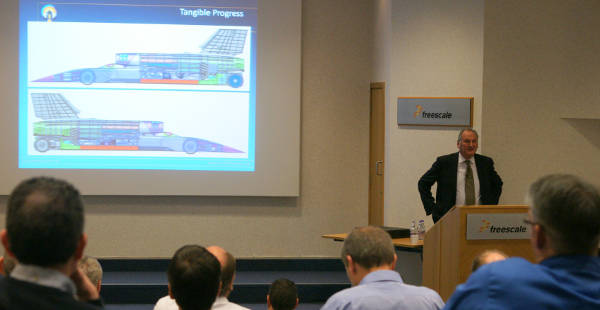
Children from local schools were invited to Freescale’s East Kilbride technology centre to build their own rocket cars as part of Freescale’s support of science technology engineering and mathematics (STEM) activities.
World land speed record supremo Richard Noble was there to help inspire the children.
SONY DSC“In the 1960s and 1970s children were inspired by the Apollo projects heading off to the moon but since then there has not been a similar level of adventure to inspire,” said Freescale. “Richard made a presentation to the children showing videos featuring land speed record challenges which were truly inspirational, and he also described the challenge of encouraging young people to undertake careers in engineering.”
The event was one of Freescale’s ‘Technical Enrichment Matrix’ activities, which are “intended to provide a platform for sharing the technical achievements within Freescale facilities around the world,” said the firm. It was run with participation from Germany and the Czech Republic, and included tours of the test lab.
04dec13FreescaleSTEM1 600A rocket car competition on the day was won by the St Andrews and St Brides school, based in East Kilbride.
Richard Noble drove Thrust 2 to the 1983 world land speed record of 633.468mph (1,019km/h). He went on to be team director for Andy Green’s 1997 763.035mph (1,221km/h, mach1.02) Thrust SSC record.

Embedded Systems Conference goes to Bristol, Cambridge, Manchester and Scotland in 2014f

UK Device Developers' Conference
The UK Device Developers’ Conference will take place in four locations next year. Starting with Bristol on Tuesday 20th May, the event will then visit Cambridge (22nd May), Manchester (3rd June) and Scotland (5th June).
Exhibiting companies and presenters will include Wind River, QNX, JTAG Technologies, LDRA and Phaedrus Systems.
These will be one-day events for electronic engineers, computer scientists, designers and developers working in the field of intelligent systems and devices.
There will be half-day technology workshops, technical presentations and a vendor exhibition of tools, software and hardware.
“We are very pleased to be adding Scotland to our agenda for 2014,” said Richard Blackburn, event organiser. “There is a lot of hi-tech industry in this region, and we feel sure that the Conference will attract many developers and that they will find it a very worthwhile investment of their time.”
The UK Device Developers’ Conference is to be sponsored by German debug tool company Lauterbach and UK based embedded systems training experts Feabhas.
The events will include a software stream of presentations and a hardware stream of presentations. Some key topics for next year event include ASIC/FPGA development, DSP development, Android development, PCB design and test, data management and security, Enclosure Design, realtime operating systems and GUI/HMI development.

STMicroelectronics’ microcontroller powers artificial-intelligence cars from Anki Drive

Global semiconductors leader, ST Microelectronics announces that its STM32 microcontroller has been selected by Anki, a robotics and artificial intelligence (AI) start-up for use in their first product, the Anki Drive.
The Anki Drive enables consumers to download an app on their compatible iOS devices to interact and race against intelligent robotic miniature race cars. 
Each car in Anki Drive analyses data from the race track 500 times per second. The performance and processing capacity of ST’s STM32 microcontroller delivers the real-time responsiveness in the Anki Drive cars, which are equipped with optical sensors, wireless chips, motors, and over 20,000 lines of code. The ARM Cortex M-based STM32 also provides excellent power efficiency giving Anki Drive users the perfect balance of functionality and battery life. 
Hanns Tappeiner, Co-Founder & President, Anki, Inc explains the STM32 microcontroller was selected for several reasons, including its computational power, footprint and peripheral portfolio. He adds the ability of the STM32 to process data quickly, as well as offer highly integrated peripherals such as a General Purpose DMA, made it into a great microcontroller for Anki Drive cars.
Michel Buffa, General Manager, Microcontroller Division, STMicroelectronics comments that they are proud to have the STM32 microcontroller, with its efficient and well-designed architecture, DMA and rich peripheral set, powering Anki’s vision.

Tuesday, 26 November 2013

Super-stretchy nanotechnology electronics

A mobile telephone display for your jacket sleeve, ECG probes for your workout clothes—wearable electronics are in demand. In order for textiles with built-in electronics to function over longer periods of time, all of the components need to be flexible and stretchable. In the journal Angewandte Chemie ("A Highly Stretchable, Fiber-Shaped Supercapacitor"), Chinese nanotechnology researchers have now introduced a new type of supercapacitor that fulfills this requirement. Its components are fiber-shaped and based on carbon nanotubes.A supercapacitor with high stretchabilityA supercapacitor with high stretchability has been developed by wrapping two layers of sheets built of aligned carbon nanotubes, which serve as two electrodes, on an elastic fiber. The use of these sheets offers high flexibility, tensile strength, electrical conductivity, and mechanical and thermal stability. The supercapacitor shows and maintains a high specific capacitance after stretching for many cycles.For electronic devices to be incorporated into textiles or plastic films, their components must be stretchable. This is true for LEDS, solar cells, transistors, circuits, and batteries—as well as for the supercapacitors often used for static random access memory (SRAM). SRAM is often used as a cache in processors or for local storage on chips, as well as in devices that must maintain their data over several years with no source of power.Previous stretchable electronic components have generally been produced in a conventional planar format, which has been an obstacle to their further development for use in small, lightweight, wearable electronics. Initial attempts to produce supercapacitors in the form of wires or fibers produced flexible—but not stretchable—components. However, stretchability is a required feature for a number of applications. For example, electronic textiles would easily tear if they were not stretchable.A team led by Huisheng Peng at Fudan University has now developed a new family of highly stretchable, fiber-shaped, high-performance supercapacitors. The devices are made by a winding process with an elastic fiber at the core. The fiber is coated with an electrolyte gel and a thin layer of carbon nanotubes is wound around it like a sheet of paper. This is followed by a second layer of electrolyte gel, another layer of carbon nanotube wrap, and a final layer of electrolyte gel.The delicate “sheets” of carbon nanotubes are produced by chemical vapor deposition and a spinning process. In the sheets this method produces, the tiny tubes are aligned in parallel. These types of layers display a remarkable combination of properties: They are highly flexible, tear-resistant, conductive, and thermally and mechanically stable. In the wound fibers, the two layers of carbon nanotubes act as electrodes. The electrolyte gel separates the electrodes from each other while stabilizing the nanotubes during stretching so that their alignment is maintained. This results in supercapacitor fibers with a high capacity that is maintained after many stretching cycles.

Read more: http://www.nanowerk.com/nanotechnology_news/newsid=33402.php#ixzz2llLWPqZz

Surge in electronics sector helped lift manufacturing output 8% in October

Singapore's factory output grew 8 per cent in October over the same month last year, boosted mainly by a surge in the electronics sector.
The electronics cluster's output expanded 22.8 per cent last month, with most segments expanding amid improved demand.
Electronics output rose 1.3 per cent from January to October this year, compared with the same period last year.
Output of the transport engineering cluster increased 8.9 per cent over last year, while the precision engineering cluster grew 5 per cent.

Electronics shipments drive PHL imports up 7.2% in Sept., says NSO

Philippine imports grew at a faster pace in September, driven mainly by a double-digit increase in electronics shipments, the country's main trade product, the National Statistics Office (NSO) reported Tuesday. 
 
The imports bill went up 7.2 percent to $5.711 billion, compared to a revised 7 percent increase in August and a 4.8 percent uptick in September 2012, NSO data showed. 
 
Imports for the first nine months of 2013 totaled $46.359 billion, up 0.03 percent year-on-year. 
 
“The rise of importation in September 2013 mirrored the buoyant outlook of firms on the volume of business activities for the third and fourth quarters... in anticipation of the increase in demand during the holiday season,” Socioeconomic Planning Secretary Arsenio Balisacan said in a separate statement Tuesday. 
 
Electronics, which account for the largest share in September, grew 29.8 percent and is a turnaround from the 9 percent contraction in August. 
 
These are usually materials used by the semiconductor and electronics industry, which produces the Philippines largest export shipments. 
 
Other top gainers in September imports were transport equipment which grew by 135.6 percent, food and live animals which were up by 13.3 percent, and industrial machinery and equipment which expanded by 2.0 percent. 
 
Balisacan noted the triple-digit rise in transport were driven by orders by Cebu Air Inc., operator of budget carrier Cebu Pacific, in line with the company plans to grow its fleet. 
 
In September, the Philippines registered a trade deficit of $666 million, wider than the $516 million  gap posted a year earlier. 
 
This brought the January to September trade deficit to $6.31 billion.  
 
Ildemarc Bautista, research head at listed Metropolitan Bank & Trust Co., said the latest imports numbers were in line with a “normalization in global trade” as growth prospects in developed economies improve.
 
“We were really expecting an uptick,” he said in a telephone interview Tuesday.  
 
Bautista, however, said Philippine trade prospects remain cloudy and will likely place a drag on gross domestic product (GDP). 
 
“We've always been a net importer, and this has sliced some numbers from total GDP,” he said. 
 
Baustista noted that imports of capital goods for reconstruction following super typhoon Yolanda, which pummeled Central Philippines on Nov. 8, is expected to bolster inbound shipments in the remaining months of the year. 
 
The United States of America was the top source of Philippine merchandise imports, accounting for 11.8-percent of the total. Second was China with an 11.5-percent share, followed by Taiwan and Japan which both accounted for 8.0 percent each. 

Philippines' Sept imports up 7.2 pct, electronics value at 2-1/2 yr high

* Electronics imports up 29.8 pct yr/yr to $1.76 bln
    * Sept trade deficit at $666 mln vs yr-ago gap of $516 mln
    * Jan-Sept trade deficit $6.31 bln vs $6.23 bln gap yr ago

    MANILA, Nov 26 (Reuters) - Philippine imports in September
rose 7.2 percent from a year ago, spurred by a double-digit rise
in its main electronics shipments, the statistics office said on
Tuesday.

KEY DATA         Sept   Aug    July   June    May    Apr    Mar 
 
Imports ($ bln)  5.71   5.55   5.49   4.86   5.26   5.14   4.92 
 
yr/yr chg (pct)  7.2    7.0    8.7   -4.8   -2.4    7.4   -8.4  
 

Electronics
Imports ($ bln)  1.76   1.34   1.63   1.10   1.28   1.06   1.25 
  
yr/yr chg (pct)  29.8   -9.0   33.1  -24.8  -11.1  -19.0   -0.6 
 
    NOTE: Some numbers for the previous month have been changed.

    KEY POINTS:
    - The country's largest imports are inputs used by the
semiconductor and electronics industry, also the biggest export
sector and a major contributor to the economy. Imports of
electronic parts in September climbed 29.8 percent from a year
earlier, with the value of electronics shipments the highest
since March 2011 at $2.05 billion . 
    - Total imports in the nine months to September were flat at
$46.4 billion from a year ago. 
    - The country had a trade deficit of $666 million in
September, wider than its year-ago gap of $516 million, bringing
the total trade gap in January-September to $6.31 billion. 
    - Exports climbed for a fourth month in a row in September,
although at a slower pace. The trade outlook remains cloudy
after the electronics industry group has said exports of the
sector will decline 10-12 percent this year, compared with its
earlier forecast of 5-6 percent growth. 
    - A super typhoon that devastated the central Philippines
could slow the country's economic growth in the fourth quarter,
but the government's full-year target of 6-7 percent is still
within reach, according to socioeconomic planning secretary
Arsenio Balisacan. 
    - Last week, the Philippine central bank raised its
inflation forecasts for this year and next, but said the faster
pace of price increases is not expected to force a rise in
interest rates just yet. The central bank will have its last
rate-setting meeting this year on Dec. 12.
 

Friday, 22 November 2013

Anti-Gravity Ball Opens New Dimensions

zeron02 600x392 Anti Gravity Ball Opens New Dimensions
MIT media lab created a metal ball which is capable of doing some extraordinary feats while being in anti gravity mode. This round shiny metal ball has been named as ZeroN and it has indeed put a great significance in manipulating technologies in a more advanced way. The ball can be controlled via computer and by hands as well, to be more precise it lets you control the communication between computer and human via physical interference.
zeron00r 600x395 Anti Gravity Ball Opens New DimensionsThe strong magnetic field controlled by the computer along with optical tracking system and a projector are used to make the ball move around. Jinha Lee, the one who has made this project has been telling that this anti gravity ball could be used in various fashions, like by projecting our solar systems and even manipulating some controls of physical motion to digital motion. The stability and the vertical hold of the ball is also appreciatable, since it has no disturbance as the magnetic field puts a firm hold over it.
More to see this thing in action, watch the video below.


Thursday, 21 November 2013

Indian techie files lawsuit against Bosch

An Indian techie has filed a lawsuit against Bosch, a German multinational engineering and electronics company, alleging that the firm compelled Indian employees in the US to pay their tax refunds back to it.
In a lawsuit filed through national plaintiffs' law firm Lieff Cabraser Heimann & Bernstein, LLP ("Lieff Cabraser"), Indian national Suraj Kamath today charged that Bosch unjustly enriched itself by requiring all of its non-US citizens employees to pay to Bosch federal and state tax refunds the employees had received while working in the US.
In the class action lawsuit filed in federal court in Los Angeles, the complaint seeks certification by the Court of a class consisting of "All non-US citizens who were, are, or will be employed by Bosch from whom Bosch has demanded payment of their tax refund amounts.
It is estimated that at least 160 persons are class members. The complaint seeks monetary damages and injunctive relief.
"I worked diligently for Bosch for years. When I objected to Bosch's demand to pay back all tax refunds I had received, Bosch threatened to fire me, send me back to India, and make my life miserable. The way Bosch treats its employees is wrong and that's why I am standing up to Bosch for myself and my fellow colleagues at Bosch," Kamath alleged.
In 2005, Kamath, a citizen of India, began working for Robert Bosch Engineering and Business Solutions, Ltd  ("RBEI") in India. In March 2009, RBEI transferred Kamath to the US, where he worked as a Project Manager in Santa Barbara, California, until May 2013.
"The Indian citizens who Bosch brought to the United States have contributed to the US economy and helped Bosch grow and prosper in America," Daniel M Hutchinson, counsel for Kamath and the proposed class, said in a statement.
"All Bosch employees should receive their full wages, and that includes the tax refunds they are entitled to. These employees deserve to be treated fairly, and not have their livelihoods threatened for insisting that Bosch comply with the law," Hutchinson said.
The complaint alleges that on December 21, 2012, Bosch sent letters to Kamath and other Bosch employees listing the amounts of tax refunds the employee had received for tax years 2006 through 2011.
Bosch directed that the employee "repay this amount" to Bosch by check before January 15, 2013, or arrange for payroll deductions by no later than December 27, 2012, the complaint alleges.
The tax refund amounts sought by Bosch totaled in the tens of thousands of dollars for many employees.
According to complaint, Kamath objected to Bosch's demand. In response, the complaint alleges that Bosch informed Kamath that, if he did not sign a form declaration promising to pay Bosch the full amount of his tax refunds, Bosch would fire him and require him to return to India.
 Bosch managers allegedy threatened Kamath, stating, "We will make sure that your career is destroyed and you will not be able to find a job anywhere. We will make your life miserable if you don't sign [the declaration promising to pay back to Bosch the tax refunds you received]."
Following Kamath's refusal to comply with Bosch's demand, Bosch required Kamath to return to India in May 2013, even though his visa was valid until March 1, 2014. In addition, Bosch refused to pay Kamath a performance pay amount that Bosch owes him for his work in 2012.
Other Bosch employees who complied with Bosch's coercive tactics have had the tax refund amounts taken by Bosch through payroll deductions, the complaint alleged.
There was no immediate reaction from Bosch.